
Blog
What Fermentation Actually Does To Kratom Leaves


Fermentation gets thrown around a lot in the Kratom world without much explanation. Vendors label certain varieties “fermented” and attach a higher price tag and a particular set of claimed effects. But what does fermentation actually mean for Kratom leaves? What’s chemically happening, why do certain cultures use it, and does it genuinely change what you’re getting in the final product? The answers about fermented Kratom are more layered than most product descriptions let on.
Try Premium Bedrock Botanicals Kratom Products
A Practice With Deep Roots
To understand fermentation in Kratom, start in Southeast Asia, where the Mitragyna speciosa tree has been part of daily agricultural and cultural life for generations. Workers in Thailand, Malaysia, and Indonesia have long chewed fresh Kratom leaves to manage fatigue during long days in the field. Certain regional traditions went further, treating leaves before use, wrapping them, stacking them in bundles, or storing them under specific conditions for days or weeks.
Read Our Certificate Of Analysis!
What those communities were doing, often without framing it in scientific terms, was triggering a fermentation-like process. Leaves were exposed to their own moisture, ambient microorganisms, and varying temperatures, producing a noticeably different product than fresh or simply dried leaf. Color changed. Aroma shifted. The character of the material transformed.
Modern fermented Kratom products trace back to that tradition, though how closely contemporary commercial processes replicate the original methods varies quite a bit.
What Fermentation Actually Means Here
Fermentation, broadly, is a biological process in which microorganisms, bacteria, yeast, and various fungi, break down organic compounds with limited or no oxygen. Most people associate it with bread, beer, or yogurt. In Kratom leaves, it operates on similar foundational lines, though the starting material and outcomes differ.
Several things happen at once. Microorganisms on the leaf surface and in the surrounding environment consume sugars and other organic material within the plant tissue. This metabolic activity produces heat, releases carbon dioxide, and progressively breaks down the leaf’s cellular structures. As cell walls degrade, the chemical compounds inside, including the alkaloids responsible for Kratom’s pharmacological effects, become more accessible and begin interacting in new ways.
Fermenting leaves also tend to darken considerably, partly from oxidation and partly from microbial and enzymatic breakdown of chlorophyll and other color molecules. That’s why fermented Kratom is often associated with dark brown or near-black batches.
The Alkaloid Story Nobody Fully Tells You
Kratom leaves carry dozens of alkaloids, but most of the conversation centers on two: mitragynine and 7-hydroxymitragynine. Mitragynine dominates in raw, freshly harvested leaf. 7-hydroxymitragynine is present in much smaller amounts but draws significant scientific attention for how it behaves in the body.
This is where fermentation matters. The two aren’t locked into a fixed ratio, mitragynine can oxidize into 7-hydroxymitragynine under the right conditions, and prolonged fermentation, with its heat, moisture, and microbial activity, appears to be one of them. The chemistry isn’t cleanly mapped. No definitive study links a given fermentation time to a specific percentage increase, and anyone claiming otherwise is guessing or selling something.
What exists is a mix of community observation, some alkaloid testing, and basic chemical logic suggesting fermented leaf likely carries a different alkaloid profile than leaf that was simply harvested and dried. Whether that difference is noticeable to any individual depends on personal biology, dose, and product quality, a separate conversation entirely.
Where The Process Turns Murky
Traditional Kratom fermentation was never a tightly regulated laboratory process. Rural farmers in Malaysia, Indonesia, and Thailand worked with what they had, leaves stacked, sometimes wrapped in moisture-retaining material like banana leaves, and left to transform naturally.
Important Interesting Topic For you!
Today, “fermented Kratom” on a commercial label is murkier than most buyers assume. Some producers genuinely follow the traditional, time-intensive method. Others use heat chambers or humidity-controlled environments to accelerate it. The result can look the part, dark, pungent, visually consistent with fermented leaf, without necessarily replicating the alkaloid changes that slow, traditional fermentation produces.
If you’re paying a premium for fermented Kratom because of what you believe it does to the alkaloid profile, it’s worth asking the vendor how their process actually works. A good vendor will explain it plainly, a vague answer tells you something too.
It Smells Different. It Tastes Different. That’s Not Trivial.
Standard dried Kratom has a familiar earthy, bitter edge. Fermented Kratom turns that up considerably, deeper, more pungent, sometimes described as barnyard-like in its richness. Some people like it. Others find it unpleasant at first.
That shift isn’t cosmetic. It’s the sensory signature of real chemistry: microbial activity breaking down cellular structures, chlorophyll degrading, organic compounds transforming over weeks of heat and moisture. Think of cabbage becoming sauerkraut, or fresh milk aging into blue cheese, same starting material, fundamentally different product because of what living organisms did to it over time. If fermented Kratom smells or tastes stronger or stranger than what you’re used to, that’s a rough indicator something real happened during processing, not a sign the product has gone bad.
What Fermentation Won’t Do
Fermentation isn’t alchemy. It doesn’t manufacture new alkaloids from nothing, and it doesn’t turn Kratom into a categorically different substance. It doesn’t guarantee a specific experience, and it doesn’t erase the wide variability in how different people respond to Kratom in any form.
What it does is shift proportions and alter chemistry at the margins, producing a product that sits in a different part of the spectrum than conventionally dried leaf. For some people that difference is meaningful; for others it barely registers. Both outcomes are valid, neither makes fermentation fraudulent or magical. Any vendor claiming fermented Kratom is dramatically stronger or superior across the board is oversimplifying.
Conclusion
Fermentation is a real, historically grounded practice in Kratom culture, and the changes it produces, chemical, visual, sensory, are genuine, not just marketing spin. At the same time, the commercial “fermented” label alone doesn’t tell you much, given how inconsistent production methods are. If you’re curious, ask vendors how they actually ferment their leaf, look for third-party lab testing on alkaloid content, and check in with a healthcare professional before adding it to any routine, genuinely worthwhile advice, not just a disclaimer.
FAQs
Is Fermented Kratom Stronger Than Regular Kratom?
Not necessarily, and not in a fixed or predictable way. Fermentation can shift the ratio of mitragynine to 7-hydroxymitragynine, but there’s no established formula linking fermentation time to potency. Strength still depends on the individual batch, dose, and person.
How Can I Tell If Kratom Was Actually Fermented Using Traditional Methods?
There’s no foolproof visual test. Dark color and a pungent smell are consistent with fermentation, but they can also result from accelerated, heat-chamber processing that may not replicate the alkaloid changes of slow, traditional fermentation. Asking the vendor directly about their process and requesting third-party lab results is the most reliable approach.
Is Fermented Kratom Safe To Try If I’ve Never Used Regular Kratom Before?
Fermented Kratom carries the same general uncertainties as any Kratom product, inconsistent regulation, variable alkaloid content, and limited large-scale research. Anyone new to Kratom, fermented or not, should talk to a healthcare professional first, particularly if they take other medications or have existing health conditions.
Related Posts
Kratom Powder Clumping: Why It Happens and How to Store It Properly

Kratom powder may sometimes come in the form of a soft, loose powder, and in other instances, it will be small chunks and/or clusters. When you open a package and realize that the powder has clumped, you’ll wonder if something is wrong, if the powder is fresh, or if the clumping means that it’s a certain level of quality. Do you know anything about Kratom powder clumping?
Thankfully, Kratom powder clumping alone does not indicate that Kratom powder is or spoiled. There are a number of reasons why a fine botanical powder might clump together, such as compression during packing, ambient humidity, heat or cold, or sealing method.
Disclaimer: This statement has not been evaluated by the Food and Drug Administration. This product is not intended to diagnose, treat, cure, or prevent any disease.
Why Kratom Powder Clumping takes Place?
There isn’t one universal reason for clumping. The appearance of the powder can change because of several different conditions.
Kratom Foam: Is It Normal Or a Cause For Concern?
1. Moisture Can Cause Powder to Stick Together
There isn’t one universal reason for clumping. The powder may look different due to a variety of factors.
Humidity or moisture exposure is one of the most popular reasons for Kratom powder clumping. Fine powders have the capacity to absorb or interact with moisture in their environment. When this occurs, single particles may lose their free-flowing nature and start clumping.
Also Read Kratom Powder Vs Capsules Vs Extracts
This may occur if:
- The package is opened and closed many times.
- The container for the storage of the material is not securely closed.
- Powder is stored in a humid condition.
- The powder comes in contact with a wet or damp measuring utensil.
- The package is left open for a longer time.
2. Vacuum Sealing Can Compress Kratom Powder
Not all clumps are caused by moisture.
Fine powder can be compressed into a dense mass in a tightly vacuum sealed package. When the pressure is applied, most of the air is expelled from the package and the powder particles are pressed together.
Consumer discussions regularly describe this exact situation, with people receiving a large compacted block that breaks apart after the package is opened.
3. Humidity in the Storage Area Matters
Where you store your Kratom can influence how easily it clumps.
A kitchen, bathroom, laundry area, or other humid location may expose the package to more moisture than a dry cupboard or cabinet.
Even if the package starts out properly sealed, repeatedly opening it in a humid room can allow environmental air into the container.
4. Temperature Changes Can Affect Powder Texture
Large or repeated temperature changes can also affect the condition of a stored powder.
For example, moving a package between a hot environment and a much cooler area can create conditions where condensation becomes possible. If moisture reaches the powder, it can encourage particles to stick together.
Rather than constantly moving your Kratom between different environments, choose one suitable storage location and keep it there.
5. Fine Powder Naturally Compacts Over Time
The texture of Kratom can also change simply because fine particles settle and become compressed.
When a bag is stored, transported, stacked, or moved around, the powder can gradually settle into a denser layer. Opening the package and gently loosening the powder can restore a more familiar texture.
This is especially noticeable with larger quantities.
A compacted appearance therefore does not automatically indicate that the Kratom is old or poor quality.
Important Interesting Topic For you!
Does kratom powder Clumping Mean Kratom Powder Is Bad?
Not necessarily.
Kratom powder Clumping alone is not enough to determine whether Kratom powder is suitable for continued storage.
Consider the overall condition instead.
A dry clump that breaks apart easily after opening may simply be the result of compression or packaging. On the other hand, powder that has an unusual smell, visible growth, obvious dampness, or other unexpected changes deserves much more caution.
In other words:
Clumping ≠ automatic spoilage.
It also does not automatically prove that the powder is fresher, stronger, newer, or higher quality.
Visual texture is only one characteristic of a botanical powder.
Read Our Certificate Of Analysis!
Can You Break Up Clumps in Kratom Powder?
If the powder is dry and has simply become compressed, gently breaking the clumps apart is generally straightforward.
You can:
- Make sure your hands and utensils are completely dry.
- Open the package in a dry environment.
- Gently loosen compacted sections.
- Use a clean, dry spoon to separate larger pieces.
- Return the powder to a suitable airtight container if you are transferring it.
- Close the container promptly after handling.
Should You Store Kratom Powder in the Refrigerator?
Refrigeration is not generally necessary for everyday storage.
In fact, repeatedly moving a container between a cold refrigerator and warmer room conditions can introduce temperature changes that may encourage condensation when the container is opened.
For ordinary storage, a cool, dry, dark cabinet is a much simpler option.
If you choose any specialized long-term storage method, the most important consideration remains keeping moisture away from the powder.
Is a Plastic Bag Enough for Kratom Powder?
A high-quality resealable bag can work for temporary or convenient storage, especially if it closes securely and is kept in a dry environment.
However, a properly sealed, rigid airtight container can provide additional protection against accidental punctures, crushing, and repeated exposure.
Some consumers report using thick resealable bags with excess air pressed out, while others prefer glass jars or airtight containers.
For everyday use, choose the option that allows you to keep the powder dry, sealed, clean, and protected from light and heat.
Does Clumping Affect Kratom’s Quality?
Clumping itself is not a reliable measurement of quality.
Some consumers associate loose powder with freshness and clumped powder with moisture, while others report receiving heavily compressed powder directly from vacuum-sealed packaging.
That conflicting experience is important.
There is no simple rule saying:
More clumping = better quality
or
No clumping = better quality.
Instead, look at the complete picture, including packaging condition, storage history, appearance, odor, and whether the powder has been exposed to moisture.
For buyers seeking high quality Kratom, responsible sourcing, appropriate packaging, transparent product information, and good storage practices are more meaningful considerations than the presence or absence of a few clumps.
What Should You Do If Your Kratom Powder Has Already Clumped?
Don’t immediately assume that the powder is unusable.
First, inspect it carefully.
If the clump is dry and appears to have resulted from compression, gently break it apart using a clean, dry utensil.
If it appears damp or has an unusual smell, visible growth, or another unexpected change, don’t try to “fix” it by drying, heating, or adding anything to the powder. Instead, separate the questionable material and contact the supplier if appropriate.
The safest approach is to avoid experimenting with visibly compromised material.
Final Thoughts: Don’t Judge Kratom Powder by Clumps Alone
Kratom powder clumping can happen for several reasons. Moisture is one possibility, but it is not the only explanation. Vacuum sealing, compression during shipping, settling, humidity, and storage conditions can all influence the texture.
The key is to look beyond the clump itself.
A dry, compacted section that breaks apart easily may simply reflect how the powder was packaged. Persistent moisture, unusual odor, visible growth, or other unexpected changes deserve greater attention.
At Bedrock Botanicals, understanding how Kratom behaves during storage can help customers make more informed decisions about handling their products. Whether you purchase smaller quantities or keep several varieties on hand, proper storage is one of the simplest ways to protect your investment in high quality Kratom.
FAQs
Why did my Kratom turn into one big clump after I opened the bag?
A tightly vacuum-sealed package can compress fine Kratom powder into a dense mass during shipping or storage.
Should I throw away Kratom if it has small clumps?
Instead of judging the powder solely by texture, check whether it is unusually damp, has an unexpected odor, shows visible growth, or has otherwise changed.
What is the best way to keep Kratom powder from getting clumpy?
Keep the powder in a tightly sealed container and store it in a cool, dry, dark location. Use only dry utensils and avoid opening the container unnecessarily.
How Long Does Kratom Powder Stay Fresh Once Opened?
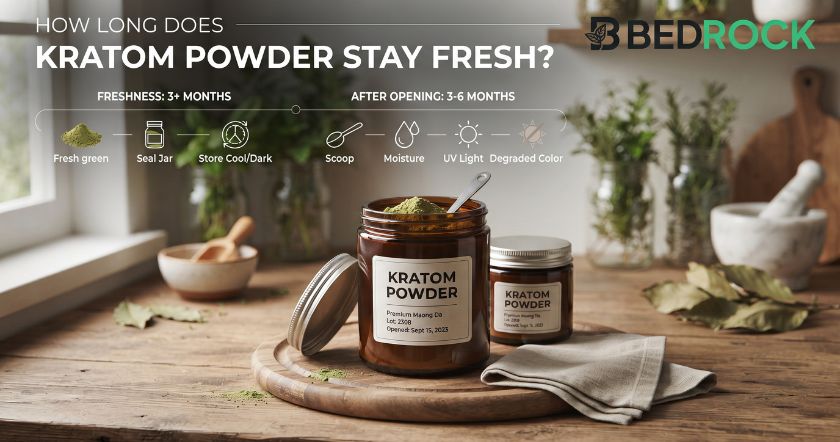
Do not assume that once the bag of Kratom Powder is opened how long does Kratom powder stay fresh? Dried powder can maintain its original characteristics for a long time if stored properly. But it is not possible to say exactly how many months or years an opened package will last; it varies. Moisture, temperature, light, air, packaging, handling and initial moisture state of the powder are all factors that affect freshness.
One of the basic methods for maintaining the color, aroma, texture and quality of Kratom Powder at home is proper storage. The main rule is simple: Store Kratom Powder in a dry, sealed container, in a cool place, and out of direct sunlight.
Important disclaimer: Kratom has not been evaluated by the FDA for the diagnosis, treatment, cure, or prevention of any disease. This content is for general informational purposes and does not make medical claims or recommend Kratom for treating any health condition.
Quick Answer: How Long Does Kratom Powder Stay Fresh?
There is no universally established shelf-life period for opened Kratom Powder. If the powder remains completely dry and is stored in a properly sealed container away from heat and light, it may retain its desirable characteristics for an extended period.
Opening the package exposes the powder to environmental conditions, but air exposure alone does not automatically make Kratom Powder useless. Moisture is typically a more pressing storage problem since dampness can lead to clumping and make it possible for unwanted microbial growth to occur.
Kratom Foam: Is It Normal Or a Cause For Concern?
The best thing to do is follow the instructions provided on the package for storing the item and check it before consuming.
What Happens to Kratom Powder After You Open It?
The powder in the package comes into contact with the surrounding when opened. All openings can allow the entry of a combination of air, humidity, light, heat and handling contamination.
Also Read Kratom Powder Vs Capsules Vs Extracts
Several factors matter most:
- Humidity: Moisture can cause powder to clump and may increase the risk of spoilage.
- Temperature: Excessive heat can negatively affect the quality of dried botanical material.
- Light: Prolonged exposure to light can contribute to changes in natural plant compounds.
- Air exposure: Repeatedly opening and closing the package increases environmental exposure.
- Container quality: A weak seal allows more humidity and air exchange.
- Handling: Wet or contaminated scoops can introduce unwanted moisture or contaminants.
Does Opening Kratom Powder Make It Go Bad Faster?
Yes, opening a package can increase exposure to environmental conditions, but opening it once does not automatically mean it will go bad.
The bigger issue is what happens after opening.
For example, a bag that is opened briefly, measured with a clean and completely dry utensil, and immediately resealed is exposed to much less moisture than a bag that remains open on a kitchen counter.
Similarly, a package kept in a humid room may experience more storage challenges than one kept in a consistently dry environment.
Think of the process this way:
Open package → environmental exposure → moisture/light/heat/air → gradual quality changes
The goal is to minimize those exposures every time the package is opened.
Try Premium Bedrock Botanicals Kratom Products
Why Is Moisture the Biggest Storage Concern?
Moisture deserves particular attention because Kratom Powder is a dry botanical material.
When humidity enters a package, the powder can begin changing from its original free-flowing texture. You may notice:
- Small clumps
- Larger hardened sections
- Changes in texture
- Dampness
- Unusual odor
- Visible signs of mold or other contamination
How Should You Store Opened Kratom Powder?
Proper storage does not need to be complicated. The objective is to create a stable environment with minimal exposure to moisture, excessive heat, and light.
1. Keep It in an Airtight Container
A good airtight container can help reduce exposure to humidity and environmental air.
If the original package has a reliable resealable closure, you may continue using it. For longer storage, some people prefer transferring the powder into a clean, completely dry, airtight container.
Glass containers with secure lids are commonly discussed for this purpose, while high-quality resealable pouches can also work well.
Important Interesting Topic For you!
2. Choose a Cool, Dry Location
A pantry, cupboard, or another consistently cool and dry area can be suitable.
Avoid locations exposed to:
- Direct sunlight
- Steam
- High humidity
- Cooking heat
- Radiators
- Hot vehicles
- Frequently changing temperatures
Read Our Certificate Of Analysis!
3. Keep Kratom Away From Direct Light
Light exposure is another factor worth controlling.
Instead of leaving a transparent container on a sunny countertop, place the sealed container inside a dark cupboard or pantry.
Opaque original packaging can provide an additional barrier against light.
The basic rule is simple:
Dark + dry + sealed is better than bright + humid + frequently exposed.
4. Always Use a Dry Measuring Utensil
This small habit can make a meaningful difference.
Never put a wet spoon, damp scoop, or recently washed utensil directly into the powder. Even a small amount of introduced moisture can affect a larger quantity over time.
5. Reseal the Package Immediately
You do not need to leave the bag open while preparing or measuring the powder.
Take out the amount you need, close the package securely, and return it to its storage location. For long-term storage, a properly sealed secondary container can provide another layer of protection.
What Are the Signs That Kratom Powder Is No Longer Fresh?
Time alone does not tell the whole story. Pay attention to changes in the powder itself.
Look at the Color
A gradual change in appearance can occur as botanical material ages, particularly with prolonged exposure to environmental conditions.
However, a dramatic or unusual change accompanied by other warning signs deserves attention.
Check the Texture
Fresh, properly stored powder should generally retain its expected dry, powdery character.
Hard, damp, unusually sticky, or heavily compacted material can indicate moisture exposure.
Some minor clumping can occur naturally and does not automatically establish contamination, but wetness is a different matter.
Smell the Powder
A familiar botanical aroma can vary between products and batches.
An unexpectedly musty, sour, fermented, or otherwise unusual odor is a reason to be cautious.
Look for Visible Contamination
If you see mold, unusual growth, insects, foreign material, or other obvious contamination, do not use the product.
Do not try to remove the affected portion and keep the remainder.
Does More Expensive Kratom Stay Fresh Longer?
Price alone does not determine how well Kratom Powder stores.
Freshness depends more on factors such as:
- Initial product condition
- Packaging
- Moisture control
- Storage temperature
- Light exposure
- How frequently the package is opened
- How the product is handled
If you want to buy Kratom powder, consider packaging quality, product information, storage instructions, and testing transparency rather than assuming price automatically determines shelf life.
Final Thoughts
There is no scientifically established universal timeframe that guarantees how long an opened package of Kratom Powder will remain fresh under every possible storage condition. The condition of the powder and the environment in which it is kept matter more than simply counting the days since opening.
A properly sealed container, a cool and dry storage location, limited light exposure, and clean handling can all help maintain the powder’s original characteristics.
The FDA states that Kratom is not lawfully marketed in the United States as an FDA-approved drug, dietary supplement, or conventional food, and the agency has specifically warned against marketing Kratom with unapproved disease-treatment claims.
FAQs
Does Kratom Powder actually expire or just lose potency?
Kratom Powder can undergo quality changes as it ages, particularly when exposed to moisture, heat, light, or poor storage conditions. However, there is no universal timeframe that determines exactly when every batch becomes unsuitable.
Is it better to store Kratom Powder in glass or the original bag?
Online discussions commonly recommend airtight storage regardless of the container material.
Can you store Kratom Powder in the freezer for years?
Freezing is frequently discussed by Kratom users, but it is not necessary for ordinary storage and can introduce condensation concerns if the package is opened while cold.
Kratom Powder Vs Capsules: Which Is Better For Beginners?
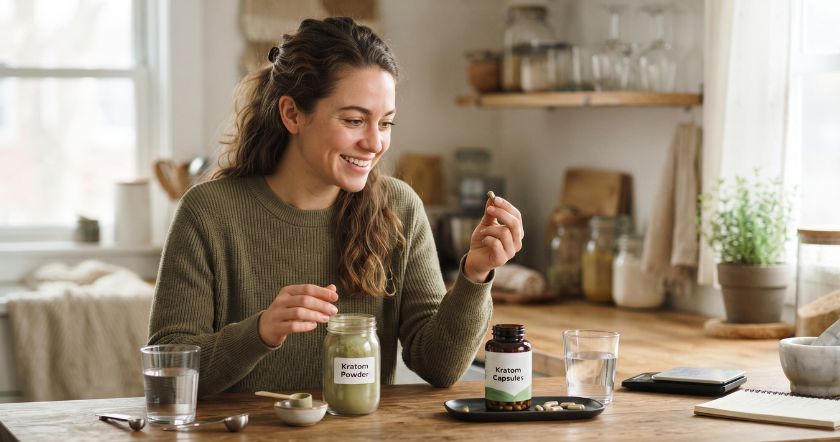
If you’re new to Kratom, one of the first decisions you’ll run into isn’t about Kratom strain or vendor; it’s about form. Do you go with the raw Kratom powder vs capsules, scooped and measured yourself, or the pre-portioned convenience of capsules? It seems like a small choice, but it actually shapes a lot of your early experience: how consistent your doses are, how quickly you feel effects, how much you spend, and honestly, how much you enjoy the process at all.
There’s no universal right answer here. Powder and capsules aren’t better or worse in some absolute sense; they’re suited to different priorities. Let’s break down how they actually compare, so you can figure out which one fits how you actually live and what you’re trying to get out of it.
What’s The Difference, Kratom Powder Vs Capsules Really?
Kratom Bedrock powder is the dried, ground leaf of the Mitragyna speciosa plant, sold loose in a bag or container. You measure it out yourself, usually with a scale or scoop, and consume it by mixing it into a drink, using the “toss and wash” method, or making tea.
Kratom Foam: Is It Normal Or a Cause For Concern?
Kratom Bedrock Capsules are that same powder, pre-measured and sealed inside a gelatin or vegetarian capsule shell. You swallow them like any other supplement or pill, with water.
That’s the whole mechanical difference. But the downstream effects of that difference are where things get interesting for a beginner.
Also Read Kratom Powder Vs Capsules Vs Extracts
The Case for Starting With Powder
You Control The Dose Exactly. This is the biggest argument in powder’s favor, especially for someone brand new. Kratom’s effects are notably dose-dependent: a small amount tends to feel different from a larger amount, and individual tolerance varies quite a bit from person to person. With powder and a digital gram scale, you can start with a genuinely small amount and adjust up in small increments over multiple sessions, which is exactly what’s recommended when you don’t yet know how your body responds.
It Works Faster: The best Kratom powder mixed into liquid, or taken via toss-and-wash, tends to be absorbed a bit quicker than capsules, since no gelatin shell first needs to dissolve in your stomach. For a beginner testing how a dose feels, that shorter feedback loop can actually be a practical advantage; you’re not left wondering an hour later whether you took too little.
It’s Cheaper Per Dose: Because you’re not paying for encapsulation, packaging, or labor, organic Bedrock Kratom powder is almost always less expensive on a per-gram basis. If you’re trying Kratom out and don’t want to commit financially before you know if you even like it, powder is the lower-risk entry point.
It’s More Flexible: You’re not locked into whatever amount a capsule manufacturer decided to put in each pill. Want to try 1.5 grams instead of 2? With powder, that’s trivial. With capsules, you’re stuck opening one up anyway, which somewhat defeats the point of using them.
The tradeoff, of course, is the taste. Kratom powder has a strong, bitter, grassy flavor that a lot of newcomers find genuinely unpleasant. Mixing it into juice, using it in “Kratom lemonade,” or blending it into a smoothie helps mask it, but there’s no getting around the fact that taste is powder’s biggest downside.
Try Premium Bedrock Botanicals Kratom Products
The Case For Starting With Capsules
No Taste, No Smell, No Fuss: This is capsules’ whole reason for existing. If the flavor of Kratom is a dealbreaker for you and for plenty of people, it genuinely is; capsules solve that problem completely. You swallow them like a vitamin and move on with your day.
Built-In Portion Control (With A Caveat): Capsules take the guesswork out of measuring, which sounds like an advantage for beginners. And it is, as long as you know exactly how much powder is in each capsule and pay attention to how many you’re taking. The caveat is real, though: it’s easy to underestimate how much you’re consuming if you don’t check the per-capsule dosage on the label, and it’s just as easy to take “one more” without really registering that you’re increasing your dose. Healthy Kratom powder makes the act of increasing a dose feel deliberate; capsules can make it feel casual.
Convenience And Discretion: Capsules travel well, don’t require a scale or spoon, and don’t produce a cloud of fine Kratom powder if you’re not careful measuring it out. If you want something you can toss in a bag and take without anyone around you knowing what it is, capsules are the more practical, lower-friction option.
The tradeoffs: slower onset, since the shell has to break down first, and a noticeably higher price per gram. You’re also somewhat at the mercy of the capsule count and fill consistency from whichever vendor you buy from, which varies more than people expect.
So Which Should A Beginner Actually Choose?
If you had to pick one starting point, powder has a slight edge for most true beginners, mainly because of dosing precision. When you don’t yet know your own tolerance, being able to measure in small, exact increments and adjust gradually matters more than convenience. A cheap digital scale (the kind used for coffee or kitchen measuring) makes this easy and is worth the small investment.
Important Interesting Topic For you!
That said, if the taste of Kratom is genuinely going to stop you from trying it consistently, capsules are a completely reasonable starting point too; just be diligent about checking the milligram amount per capsule on the label, and resist the urge to round up “just one more” without doing the math on total dose.
Some people end up using both: powder at home, when they want to measure carefully, and capsules for travel or convenience. There’s nothing wrong with treating this as a spectrum rather than a permanent choice.
Read Our Certificate Of Analysis!
Final Thoughts
Neither powder nor capsules is objectively superior; they’re just different tools that trade precision and cost for taste and convenience. As a beginner, the priority should be getting comfortable with how your body responds at a small, measured dose, however you get there. Once you’ve got a sense of what works for you, switching forms later is easy and doesn’t require starting over.
FAQs
Do Powder And Capsules Produce Different Effects?
No, since capsules simply contain the same powder in a sealed shell, the underlying substance is identical. The main practical difference is speed of onset, since a capsule shell needs time to dissolve before the powder is released.
How Do I Know How Much Powder Is In A Capsule?
Check the product label or the vendor’s product page; reputable sellers list the milligram amount per capsule. If it’s not listed anywhere, that’s a sign to look for a more transparent vendor.
Is It Cheaper To Buy Powder And Make My Own Capsules?
Often, yes. Empty capsules and a simple capping machine are inexpensive, and buying Kratom powder in bulk is typically the lowest-cost option per dose if you’re willing to do the measuring and filling yourself.
Why Does Kratom Powder Taste So Bad?
The bitterness comes from the plant’s natural alkaloid content, the same compounds responsible for its effects. There’s no way to remove the bitterness without altering the product, which is part of why so many people prefer Kratom capsules or mix powder into strong-flavored drinks.
Can I Just Open A Capsule And Use The Powder Inside Instead?
Yes, that works fine and gives you back the Kratom dosing flexibility of loose powder, though it defeats the taste-masking benefit that made capsules appealing in the first place.

What To Do If Your Kratom Order Gets Delayed At Customs/Shipping
A particular kind of dread sets in when you check your tracking number and see the words “held by customs” instead of “out for delivery.” If you’ve ordered Kratom online, this isn’t a rare glitch; it’s a known risk of buying a product that sits in a legal gray zone at the federal level, even in states where it’s perfectly legal to own. Are Kratom order delayed at customs or shipping?
This isn’t meant to scare you off. Most Kratom order delayed at customs aren’t gone forever, and there are concrete things you can do while you wait. But it helps to understand the mechanics of why this happens before you decide what to do about it.
The Real Reason: FDA Import Alert 54-15
Kratom itself isn’t illegal under federal law. The DEA looked at scheduling it back in 2016, walked that back after public pushback, and it remains unscheduled today. So why does it keep getting stopped at the border?
The answer is a standing FDA directive called Import Alert 54-15. It authorizes U.S. Customs and Border Protection to detain Kratom shipments Kratom Bedrock capsules, Bedrock Kratom powder, Kratom leaf, Kratom Bedrock extracts– all of it without even opening the box to inspect it. The FDA’s official position is that Kratom is a “new dietary ingredient” that hasn’t been proven safe, and that classification alone is enough to justify a hold if the shipment looks like it’s intended for people to consume.
This alert has been in place in some form since 2012 and gets periodically updated with new companies added to its watch list. So this isn’t a new crackdown; it’s a long-running, well-established piece of the regulatory landscape that most Kratom vendors have simply learned to work around, with varying success.
Kratom Foam: Is It Normal Or a Cause For Concern?
What Actually Triggers A Hold – kratom order delayed at customs
Not every Kratom shipment gets stopped. A handful of factors raise the odds:
How It’s Labeled. Packaging or paperwork that describes the product as a supplement, something to brew, or something to swallow is a red flag. Kratom products framed as botanical specimens or “not for human consumption” face somewhat less scrutiny, even if buyers know exactly what they’re for.
Who Shipped It. Certain overseas and domestic suppliers are specifically named on the FDA’s watch list because of prior violations. Orders from those companies get flagged more consistently.
Sheer Randomness. Ports run rotating inspection sweeps, and sometimes a package just gets caught in one regardless of who sent it.
Sloppy Paperwork. A vague customs declaration or a mismatch between the stated contents and the actual product can trigger a manual review independent of anything Kratom-specific.
What To Do While You Wait
Check The Tracking Details Closely. There’s a big difference between a shipment that’s simply slow, stuck in a regional hub, delayed by weather, backed up during a holiday rush, and one explicitly marked as held for inspection. Only the second situation is a customs issue in the sense this article is about.
Message Your Vendor Right Away. This is the single most useful thing you can do. Vendors who’ve been in the Kratom business for any length of time have seen this before, often on the same shipping route. Tell them your order number and what your tracking shows, and ask plainly what their policy is if the package doesn’t clear. A vendor worth ordering from again will usually offer one of the following:
Try Premium Bedrock Botanicals Kratom Products
- A reshipment through a different route or facility
- A refund or store credit if the package is officially seized
- Specific insight into how long that particular port typically takes
Watch Your Mail For An Official Notice. If CBP or the FDA formally detains your shipment, they’ll usually send a written Notice of Detention explaining why, sometimes with a deadline to respond with supporting documentation. For a one-off personal order, going through the formal appeals process is rarely worth the time or cost; the standard of proof needed to show the product isn’t for consumption is a high bar to clear, and it’s really designed for commercial importers, not someone who ordered a bag of Kratom for personal use.
Set A Mental Deadline. If there’s been no movement and no notice after three or four weeks, it’s reasonable to treat the order as lost and start the refund conversation rather than keep refreshing the tracking page.
The Three Ways This Usually Ends
- It clears, just later than expected. This is what happens most often with smaller personal orders, particularly from vendors who ship in a way that doesn’t scream “supplement.”
- It gets destroyed or sent back to the shipper. This happens when CBP decides the product doesn’t meet import requirements.
- You get a formal notice with a response window. Less common for individual buyers, more common with larger or repeat commercial shipments.
Cutting Down The Odds Next Time
If you plan to keep ordering Kratom, a few habits meaningfully lower your risk of a repeat delay:
- Stick with vendors who’ve been operating for years and are upfront about how they handle customs issues, rather than vendors who avoid the topic entirely.
- Favor U.S.-based domestic warehouses when they’re an option. Kratom order delayed at customs already inside the country skips the import-alert exposure entirely.
Important Interesting Topic For you!
- Be wary of unusually large orders, which read differently to customs than a small personal quantity.
- Double-check your own state and city laws. Some places have banned Kratom outright, and a shipment can be blocked locally even if it clears federal customs just fine.
Conclusion
A Kratom order delayed at customs is annoying, but it’s usually not catastrophic. The fastest path forward is almost always talking to your vendor rather than trying to intervene with customs yourself. And the vendors worth sticking with are the ones who treat this as a normal, if unfortunate, part of doing business, not something they pretend never happens.
Read Our Certificate Of Analysis!
FAQ’s
Can Kratom Legally Be Mailed To Me In The U.S.?
It depends entirely on where you live. Kratom is legal to possess in most states, but a growing number of states and cities have banned or restricted it. Separately, federal customs can still hold or refuse shipments under the FDA’s import alert regardless of your state’s laws.
How Long Does A Customs Hold Typically Last?
There’s no set timeframe; some orders clear within a week of the extra delay, while others take a month or longer. As a rule of thumb, if three to four weeks pass with no update, assume the shipment isn’t coming through.
Could I Get In Legal Trouble Over A Seized Personal Order?
Realistically, no. Enforcement under the import alert targets the shipment and the importer of record, not individual buyers placing a normal personal-use order.
Will The Vendor Refund Me If My Package Gets Seized?
Many will, but it’s a matter of store policy, not a legal requirement. Ask before you order, especially if you’re buying from a new vendor for the first time.
Does Packaging And Labeling Really Make A Difference?
Yes. Shipments explicitly marketed as dietary supplements or something to ingest draw more scrutiny under the FDA’s alert than items labeled as botanical or novelty products, even if the actual contents are identical.

Kratom and Work Productivity: Real User Scenarios
Organizing your time, energy, and attention is essential to productivity for many working adults. Some adults who use Kratom describe using it as a part of their routine. It helps and prepares them for a long workday or stay focused on their work which can include repetitive, straightforward tasks. While many adults cannot prove that Kratom increases productivity or is a cure for any health ailment.
This article takes a practical look at Kratom and work productivity through realistic, non-medical user scenarios. Instead of promising specific outcomes, the focus is on how people may describe their routines, what variables can influence their experience, and why responsible product information matters.
What Does Productivity Mean When Discussing Kratom?
Productivity is about more than just getting more tasks done.
Productivity in the workplace can be defined in many ways including:
- staying focused on the task at hand
- sticking to a schedule with daily tasks
- maintaining task order and priority
- self-control and consistency
- purposefully having breaks
- removing distractions from your work
- finishing tasks
Red Bubble Kratom: A More Effective Way to Consume?
Considering all the intricacies involved with productivity, attributing increased performance to a single product would not be sound logic.
Sleep, task difficulty, work environment, food and hydration, personal expectations, and numerous other aspects can all influence productivity.
So when discussing Kratom and productivity, it is more appropriate to talk about what users report their experience and routines are, rather than stating that Kratom improves productivity.
Why Are Some People Interested in Kratom for Their Work Routine?
People encounter Kratom in many different contexts. Some users describe particular preparations as fitting into their routines around work, study, creative projects, or other activities requiring sustained engagement.
Try Premium Bedrock Botanicals Kratom Products
However, an individual’s description is not the same thing as scientific evidence.
For example, someone might say:
“I include Kratom in my morning routine before starting a long project.”
That statement describes personal behavior. It does not establish that Kratom increases productivity, improves concentration, or produces the same experience for another person.
This distinction is especially important for brands creating educational or promotional content.
The FTC emphasizes that advertising claims need appropriate substantiation, particularly when products are associated with health-related benefits. Testimonials also cannot be used as a workaround for unsupported claims.
Real User Scenario 1: The Remote Worker With a Long To-Do List
Imagine a remote worker beginning the day with several hours of uninterrupted computer work.
Their routine might look something like this:
8:00 a.m. — Review emails and schedule
8:30 a.m. — Begin the most demanding project
10:30 a.m. — Take a short break
11:00 a.m. — Continue project work
1:00 p.m. — Lunch
2:00 p.m. — Administrative tasks
4:00 p.m. — Review completed work
A person who uses Kratom may choose to incorporate it into their existing routine. Their perception of the workday could be influenced by many things besides Kratom, including whether they slept adequately, how much work they had, and how distracted they were.
Important Interesting Topic For you!
What Can Influence the Experience?
A remote worker might also consider:
- How demanding the day’s workload is
- Whether meetings interrupt focused work
- Their normal sleep schedule
- Food and hydration
- Screen time
- Break frequency
- Workplace distractions
- Expectations about the product
Separating these variables can help people better understand their own routines without turning an individual experience into a universal claim.
Read Our Certificate Of Analysis!
Real User Scenario 2: The Creative Professional
Consider a designer, writer, photographer, or other creative professional working on a project that requires several hours of uninterrupted activity.
Their work may include:
- Brainstorming
- Drafting
- Editing
- Research
- Reviewing visual concepts
- Making revisions
- Organizing project files
A user may describe Kratom as something they include in their creative-work routine.
But creativity is particularly difficult to measure objectively.
For this reason, responsible content should avoid statements such as “Kratom boosts creativity” or “Kratom makes you more productive.”
A safer approach is to describe the person’s routine and subjective experience without presenting it as an established product effect.
Real User Scenario 3: The Freelancer Managing Multiple Projects
Freelancers often move between completely different types of work throughout the same day.
For example:
| Time | Task |
| 8:30 a.m. | Client emails |
| 9:00 a.m. | Content writing |
| 11:00 a.m. | Client revisions |
| 12:30 p.m. | Lunch |
| 1:30 p.m. | Research |
| 3:00 p.m. | Administrative work |
| 4:00 p.m. | Project planning |
| 5:00 p.m. | Invoicing |
A freelancer may have a personal routine involving Kratom, but the productivity outcome is difficult to isolate.
Perhaps they completed more work because they had fewer meetings that day. Perhaps they had already planned their tasks the night before. Perhaps the project itself was easier.
This is why correlation should not automatically be treated as causation.
If someone says, “I felt more prepared to work after following my usual routine,” that is a personal observation not evidence that Kratom caused the result.
Real User Scenario 4: The Worker Handling Repetitive Tasks
Not every job involves creative projects.
Many workplaces include repetitive responsibilities such as:
- Data entry
- Inventory organization
- Document processing
- Packaging
- File management
- Basic administrative tasks
- Routine computer work
Real User Scenario 5: The Person With an Inconsistent Schedule
Some workers don’t have traditional 9-to-5 schedules.
Their working hours may change from day to day:
- Monday: 7 a.m.–3 p.m.
- Tuesday: 11 a.m.–7 p.m.
- Wednesday: 2 p.m.–10 p.m.
- Thursday: 9 a.m.–5 p.m.
For someone with an inconsistent schedule, the broader routine may matter more than any individual product.
Keeping consistent habits around meals, hydration, sleep, task planning, and breaks can make a work schedule easier to manage.
If Kratom is part of someone’s personal routine, they should avoid assuming that changing the timing or amount will automatically produce a better workday.
Kratom and Work: What Responsible Content Should Avoid
For Kratom-related marketing, wording matters.
Avoid presenting Kratom as a solution for:
- A medical condition
- A psychiatric condition
- Substance withdrawal
- A disease
- A diagnosed disorder
- A specific medical symptom
- A replacement for professional treatment
Also avoid testimonials suggesting that someone used Kratom to overcome a medical condition or discontinue prescribed or illicit substances.
FDA warning letters demonstrate why disease-treatment language can create significant regulatory concerns. The agency has previously cited Kratom marketers for claims involving opioid addiction and withdrawal, among other purported therapeutic uses.
Key Takeaways
When discussing Kratom and work productivity, keep these principles in mind:
- Individual experiences are not proof of a universal productivity effect.
- Productivity depends on many variables beyond any single product.
- Avoid disease, treatment, cure, withdrawal, or therapeutic claims.
- Do not use testimonials to imply unsupported health benefits.
- Measure productivity through actual work outcomes rather than feelings alone.
- Keep product information factual and transparent.
- Distinguish ordinary Kratom discussions from concentrated 7-OH products.
- Follow applicable advertising and labeling requirements.
Important disclaimer: This statement has not been evaluated by the Food and Drug Administration. This product is not intended to diagnose, treat, cure, or prevent any disease.
FAQs
Can you work while using Kratom?
People’s experiences with Kratom can differ substantially. Anyone considering Kratom should understand the product’s potential risks, review applicable laws and product information.
Can Kratom affect driving or operating machinery?
Kratom may affect individuals differently, and people should not assume they can safely drive or operate machinery after using it.
Is Kratom FDA approved for improving productivity?
No. The FDA has not approved Kratom products as drugs for improving productivity or for other medical uses.
Can You Mix Different Kratom Strains? What Happens?
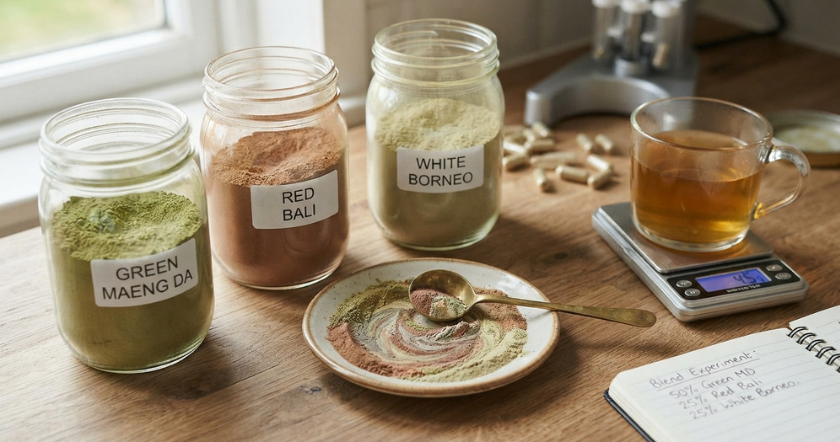
Because different Kratom strains like Green Maeng Da and Red Bali are sold separately, many people buy a selection of multiple strains and wonder what happens when they mix them.
Can you mix different Kratom strains? Physically, yes you can combine Kratom powders or other Kratom products. However, there is limited scientific research specifically examining combinations of commercial Kratom “strains,” so it is difficult to predict exactly what will happen when they are mixed. Because of differences in processing and quality, the same name may not even include the same alkaloids at the same concentrations.
Important disclaimer: Kratom has not been evaluated by the FDA for safety or effectiveness for any medical use. Information in this article is for general educational purposes and should not be interpreted as medical advice, diagnosis, treatment, or a recommendation to use Kratom.
What Does It Mean to Mix Different Kratom Strains?
When people reference “mixing Kratom strains,” they almost always mean combining products before they consume them.
This might mean they combine:
- One green strain and one white strain
- One red strain and one green strain
- Two green strains
- Products from different regions
- Products from different vendors
- Powder from one batch with powder from another batch
When people speak of “strains” they may be using a term that is not scientifically precise.
Red Bubble Kratom: A More Effective Way to Consume?
Why Consumers Combine Kratom Strains?
There are multiple consumer reasons in regard to experimenting with the different products.
To Analyze Different Product Types
Some users enjoy comparing the general characteristics of similar products.
They like to compare the Green variety with the White variety and the Red one. These consumers apparently prefer combining the varieties for their personal experimentation as opposed to utilizing the varieties individually.
To Get Experiences of Different Kinds
Some Kratom vendors try describe their products in terms such as:
- Energizing
- Relaxing
- Balanced
- Smooth
- Focused
- Calm
- Social
However, these descriptions are not standardized. Two products with similar names can produce different experiences.
3. They Have Multiple Products Available
Sometimes, people mix different products because they have different leftover products.
Rather than reducing and finishing each product individually, consumers combine products.
4. They Are Experimenting With Ratios
Some consumers create their own blends by combining different varieties in different proportions.
The problem is that changing the ratio changes the overall mixture, while the exact chemical composition may still be unknown.
That makes it difficult to predict the result from the label alone.
Kratom Foam: Is It Normal Or a Cause For Concern?- Read Here
Does Mixing Kratom Create a New Strain?
No—not in the botanical sense.
Combining two Kratom powders does not create a new genetically distinct Kratom strain.
It creates a blend.
For example, combining Green Malay and Red Bali produces a mixture containing both products. It does not cause the plants themselves to become a new variety.
This distinction matters because the term “strain” is sometimes used loosely in Kratom marketing.
What Should You Consider Before Mixing Kratom Products?
If someone is considering combining Kratom products, product information and consistency deserve particular attention.
Check the Product Label
Look for information such as:
- Botanical name
- Product type
- Batch or lot number
- Manufacturer or vendor information
- Serving information
- Manufacturing or packaging details
- Testing information
Avoid assuming that an attractive strain name tells you everything about the product.
Look for Independent Laboratory Testing
A Certificate of Analysis (COA) can provide more useful information than a strain name alone.
Depending on the laboratory and testing program, a COA may provide information about:
- Alkaloid measurements
- Microbial testing
- Heavy metals
- Contaminants
- Identity
- Product-specific testing results
Independent testing cannot guarantee that a product is appropriate for every individual, but it can provide additional information about what was measured in a particular batch.
Can Mixing Different Kratom Colors Change the Experience?
Consumers often associate Kratom colors with different characteristics:
| Kratom Label | Common Marketplace Description |
| Green | Often described as balanced or versatile |
| White | Often described as more stimulating or energetic |
| Red | Often described as more relaxing |
| Yellow/Gold | Often marketed as a blended or processed variety |
The color of a Kratom product can be influenced by leaf maturity, drying, fermentation, processing, and other factors. Consequently, consumers should not assume that every product carrying the same color label has identical properties.
When two colors are mixed, their characteristics don’t necessarily combine in a predictable “50/50” way.
What About Mixing Green and White Kratom?
Green-and-White combinations are commonly discussed among Kratom consumers.
Someone might expect the combination to create a middle-ground experience.
But there is no scientifically established formula showing that Green plus White will consistently produce a particular result.
The actual outcome can depend on the specific products involved.
For example:
Green Product A + White Product B ≠ Green Product C + White Product D
Even though the labels look similar, their underlying compositions may differ.
That is why broad promises about the outcome of a specific strain combination should be avoided.
What About Mixing Red and Green Kratom?
Red-and-Green combinations are another type of blend consumers may encounter.
A consumer may expect the Red variety’s commonly marketed characteristics to combine with those associated with Green.
However, there is insufficient evidence to establish a predictable effect from this particular combination.
The safest way to describe such a blend is simply as a combination of two Kratom products with potentially different chemical profiles, rather than claiming that it produces a guaranteed result.
What About Mixing Several Strains at Once?
Mixing two products is already difficult to predict.
Adding three, four, or more products introduces even more variables.
For example, a blend containing:
- Green Maeng Da
- Red Bali
- White Borneo
- Gold Malay
may sound carefully formulated from a marketing perspective, but the names alone don’t tell you the final alkaloid profile.
Every additional product adds another variable to the mixture..
What Should You Avoid Mixing With Kratom?
The question shouldn’t only be “Can I mix two Kratom strains?”
It is also important to consider whether Kratom is being combined with other substances.
Because interaction research is limited, combining Kratom with alcohol, sedating substances, prescription medications, recreational drugs, or other botanicals can introduce additional uncertainty.
A particularly important distinction involves concentrated products containing 7-OH. The FDA specifically advises consumers to avoid 7-OH products because of safety concerns.
If someone takes prescription or over-the-counter medications, discussing potential interactions with a qualified healthcare professional is a more appropriate approach than assuming that a Kratom combination is compatible.
The Bottom Line: Can You Mix Different Kratom Strains?
Yes, different Kratom products can physically be combined to make a blend. However, there is no reliable scientific formula for predicting exactly what a particular combination will feel like.
The biggest reason is variability.
Different products can contain different amounts of naturally occurring alkaloids, and commercial Kratom products are not standardized to a single chemical profile.
FAQs
Can you mix two Kratom strains in the same drink?
Yes, consumers can physically combine different Kratom powders in the same drink. However, the resulting experience can be difficult to predict.
How long should you wait before trying a different Kratom strain?
There isn’t a scientifically established waiting period that applies to everyone. The more important consideration is avoiding rapid experimentation with multiple products at once.
What is the difference between a Kratom blend and a Kratom strain?
A Kratom strain is a marketplace label commonly associated with a particular variety, color, or geographic name. A blend is a mixture of two or more Kratom products.
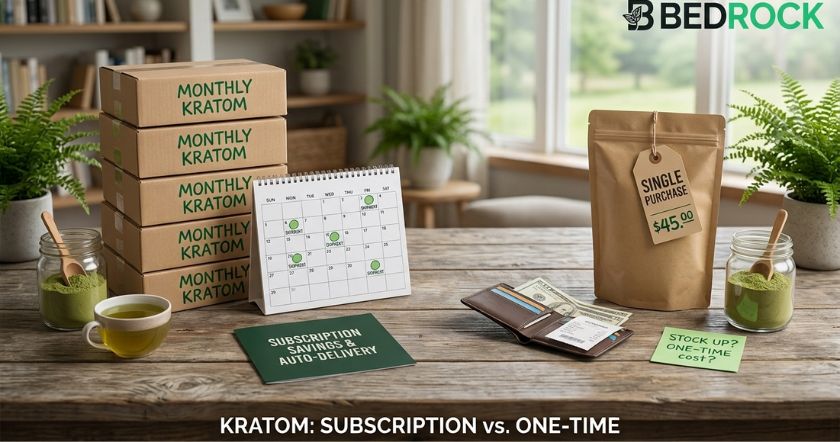
Subscription vs One-Time Kratom Buying: Which Saves More?
When it comes to Kratom, most buyers want to know how to save the most money with their purchase. This can be difficult to determine since many different factors contribute to price. Discounts, shipping costs, loyalty programs, and how often you make purchases all contribute to the total you spend. This leads many customers to the same question. Is it more cost effective that Kratom subscription vs one-time buying when you run low?
There are benefits to both options. Subscriptions tend to have special, recurring discounts and members receive their orders automatically, while one-time purchases allow the buyer to make a purchase whenever they choose and are completely flexible. Because these factors are so personal, cost effective Kratom can sometimes be one of the most difficult things to find.
FDA Disclaimer: The Kratom statements included within this document have not been evaluated by the FDA. The Kratom with which we are concerned is not intended to treat, cure, or prevent any illnesses.
Why Kratom Subscription vs One-Time Buying Strategy Matters
People think that the lowest product price means they have saved the most money. They are actually wrong. The price of a product may not mean as much to the buying strategy and how much people spend annually.
A customer who pays full price every month and pays for shipping may spend a lot more in the year than a customer who is on a subscription with no shipping costs.
The annual total depends on many factors like:
- Cost of the Product
- Shipping Costs
- Subscription Cashback
- Discounts
- Reward Points
- How often you order
- How convenient the delivery is
- Product Availability
What Is a Kratom Subscription?
A subscription is a recurring purchasing plan with Kratom Bedrock products. You select a product and it is shipped on your selected time.
For these vendor subscriptions, you may choose from delivery time spans like:
- Every 2 weeks
- Every month
- Every 6 weeks
- Every 2 months
Unlike old subscriptions that locked you into a long contract, most subscription services are flexible.
Many companies allow customers to:
- Skip a shipment
- Pause deliveries
- Change quantities
- Switch products
- Delivery dates
- Cancel at any time without a fee
The goal is to incentivize regular purchasing.
Important Interesting Topic For you!
What Is One-Time Kratom Buying?
This is the traditional buy product when you need to buy. There is no enrollment in a recurring program to get a product.
There are no scheduled deliveries or automatic charges.
This is a very flexible way to order because each order gives you control over product selection, order quantity, purchase timing, and buying restraint until a sale occurs. However, flexibility comes at a cost, as this ordering system may not provide the best long-term deal.
What Is The Cost Difference?
The biggest advantage of subscriptions is predictable savings.
Many retailers reward subscribers because recurring orders help them better manage inventory and customer demand.
Subscription benefits often include:
| Feature | Subscription | One-Time Purchase |
| Product Discount | Often available | Standard pricing |
| Automatic Deliveries | Yes | No |
| Shipping Savings | Frequently included | Depends on order |
| Loyalty Rewards | Often higher | Standard |
| Exclusive Promotions | Common | Limited |
Benefits of Choosing a Subscription
Subscriptions offer more than lower prices.
Many customers appreciate the convenience and consistency they provide.
Consistent Savings
Perhaps the biggest advantage is receiving the same discount every order instead of waiting for occasional promotions.
Even small monthly savings can add up over an entire year.
Automatic Deliveries
Running out of products unexpectedly can be frustrating.
Automatic shipments eliminate the need to remember when it’s time to reorder.
Your selected products arrive according to your preferred schedule.
Better Budget Planning
Regular monthly costs make budgeting easier.
Instead of unpredictable purchases throughout the year, subscriptions create a consistent spending pattern.
Reduced Shipping Expenses
Shipping fees may seem small individually, but repeated charges throughout the year can become substantial.
Subscriptions frequently include discounted or free shipping.
Advantages of One-Time Buying
Subscriptions aren’t the right choice for everyone.
Many shoppers prefer purchasing only when necessary.
Complete Flexibility
You remain free to:
- Change products anytime
- Try different options
- Purchase different quantities
- Shop at multiple retailers
There is no recurring commitment.
Easier for Occasional Buyers
If you purchase only a few times each year, a subscription may not provide meaningful savings.
One-time buying ensures you only pay when you actually need products.
Opportunity to Shop Seasonal Sales
Holiday promotions can sometimes offer discounts larger than regular subscription pricing.
Shoppers who monitor special promotions may occasionally secure excellent deals.
No Automatic Billing
Some people simply prefer maintaining complete control over every purchase.
Without recurring payments, there is no concern about forgetting an upcoming shipment.
Which Buying Method Fits Your Lifestyle?
Choosing between subscriptions and one-time purchases depends largely on your shopping habits.
A subscription may be ideal if you:
- Purchase every month
- Prefer consistent budgeting
- Like automatic deliveries
- Buy similar products regularly
- Want ongoing savings
One-time buying may be better if you:
- Purchase occasionally
- Frequently explore different options
- Prefer shopping during promotions
- Don’t want recurring payments
- Need complete purchasing flexibility
Neither option is universally better.
The best choice depends on your individual buying pattern.
Tips for Saving Money Regardless of Your Buying Method
Whether you subscribe or purchase individually, smart shopping habits can reduce overall spending.
Compare Total Cost Instead of Product Price
Always calculate:
- Product price
- Shipping
- Discounts
- Reward points
- Promotional offers
The lowest listed price isn’t always the best value.
Purchase Appropriate Quantities
Larger packages often reduce the price per serving or gram compared to multiple smaller purchases.
However, only buy quantities you expect to use within a reasonable timeframe while storing products properly.
Join Loyalty Programs
Many reputable vendors reward repeat customers with points or discounts that reduce future purchase costs.
Even one-time buyers can often benefit from these programs.
Watch for Promotional Events
Seasonal sales remain an excellent opportunity for customers who don’t subscribe.
Planning purchases around these events may generate worthwhile savings.
Buy From Trusted Vendors
Price alone should never be the only consideration.
Choosing reputable retailers that emphasize quality standards, transparent labeling, and customer service helps ensure a better purchasing experience.
Final Thoughts: Which Option Saves More?
There is no universal winner because every customer shops differently.
For people who purchase Kratom consistently throughout the year, subscriptions often provide the greatest long-term value. Recurring discounts, lower shipping costs, automatic deliveries, and loyalty rewards can produce meaningful annual savings while simplifying the buying process.
The smartest decision is to evaluate your own purchasing habits, compare total yearly costs rather than individual product prices, and choose the option that fits both your budget and lifestyle.
If you’re looking to buy Kratom online, Bedrock Botanicals offers high quality Kratom, transparent product information, and dependable service to help you shop with confidence. Whether you prefer the convenience of subscriptions or the flexibility of one-time purchases, choosing a trusted retailer ensures you’re making a worthwhile investment in product quality and customer experience.
FAQs
Can I cancel a Kratom subscription anytime?
Many reputable vendors allow customers to pause, modify, or cancel subscriptions. Always review the retailer’s subscription terms before enrolling.
Is one-time buying better for first-time customers?
Yes. One-time purchases allow new customers to explore different products and purchasing patterns before deciding whether a subscription fits their needs.
What should I compare besides price?
Consider shipping costs, loyalty rewards, subscription discounts, customer service, delivery flexibility, and the retailer’s reputation when comparing buying options.
How can I save money regardless of which option I choose?
Compare total order costs, join loyalty programs, watch for promotions, purchase appropriate quantities, and buy from trusted vendors that prioritize transparency and quality.

How To Tell If Your Kratom Vendor Is Overpricing You
Let’s be honest, most of us have been there. You find a Kratom vendor, you like the Kratom product, and you just keep buying from them without ever stopping to wonder whether you’re being charged a fair price. Then one day you stumble across another vendor, see their prices, and feel that sinking feeling in your stomach. Are your vendors overpricing you?
The Kratom industry is largely unregulated, which means pricing is all over the place. There’s no universal standard, no government-set price floor or ceiling, and vendors know that loyal customers rarely shop around. That gap between what Kratom should reasonably cost and what some vendors charge? It can be surprisingly wide.
Here’s how to figure out whether your vendor is treating you fairly, or quietly cashing in on your loyalty.
Try Premium Bedrock Botanicals Kratom Products
1. You’re Paying More Than $15 Per Ounce For A Basic Strain
This is probably the quickest gut-check you can do. Standard Kratom strains Green Maeng Da, Red Bali, White Borneo are widely available and not particularly hard to source. If your vendor is charging you $18, $20, or more per ounce for a best Kratom powder with no special processing or testing claims, that’s a red flag.
Reputable mid-range vendors typically price Kratom powder somewhere between $8 and $14 per ounce, depending on quantity. Bulk pricing (250g, 500g, 1kg) should drop that per-ounce cost noticeably. If it doesn’t, you’re either paying a brand tax or your vendor is simply being greedy.
2. Bulk Discounts Are Barely There
Every legitimate Kratom vendor offers meaningful bulk savings. That’s just how the supply chain works they pay less per kilo when buying large quantities, and that saving should trickle down to you.
If a vendor sells 1 oz for $12 and their 1kg price only works out to $9 per ounce barely a 25% savings despite buying 35 times more something isn’t adding up. Compare this to vendors who routinely drop per-unit costs by 40–60% at the kilo level.
That’s the kind of pricing that reflects an honest margin, not a vendor squeezing every dollar they can.
3. They Can’t Tell You Much About Their Lab Testing
Lab testing specifically, third-party COAs (Certificates of Analysis) costs vendors money. Some vendors pass that cost to consumers transparently and charge a slight premium to cover it. That’s completely reasonable.
But some vendors are overpricing premium prices and can’t produce clear lab results. They’ll say things like “we lab test everything” without giving you an actual COA, or they’ll show a single test result from two years ago for one product out of fifty. If you’re being charged top dollar, you should be getting top transparency. Period.
Lab testing is a legitimate reason for slightly higher prices. Mystery markups are not.
4. Shipping Costs Feel Like An Extra Revenue Stream
This one sneaks up on people. A vendor prices their product competitively but then tacks on $8–$12 in shipping for a small order. Meanwhile, plenty of vendors offer free shipping on orders over $30, $40, or $50 thresholds most regular buyers hit easily.
Inflated shipping charges are one of the oldest tricks in e-commerce, and the Kratom space is no exception. Always calculate the final checkout price, not just the product price. A vendor selling Kratom powder at $10/oz with $10 flat shipping is often more expensive in practice than one selling at $11/oz with free shipping above $40.
Important Interesting Topic For you!
5. Their “Premium” Labels Aren’t Backed By Anything Concrete
“Premium,” “ultra-enhanced,” “gold reserve” these words appear constantly in Kratom marketing. Sometimes they reflect something real (enhanced organic Kratom products do involve additional processing). Often they’re just words used to justify a higher price tag.
Ask yourself: does this vendor explain why a product is premium? Do they reference alkaloid percentages, specific harvest regions, or processing methods? Or is “premium” just a label they slapped on a product to charge an extra $5 per ounce? When the marketing is vague, and the price is high, your wallet deserves a better explanation.
6. Doing a Price Comparison Takes Two Minutes
Pick three or four well-known, AKA-accredited (American Kratom Association) vendors and get the price for the same Kratom strain and quantity from each. You don’t need to buy from them, just compare. Aim for the same weight (say, 250g of Green Maeng Da powder) and check:
- Base Kratom product price
- Any applicable discount codes (most vendors have them)
- Shipping cost to your zip code
- Whether they publish third-party lab results
This exercise takes about ten minutes and can save you a surprising amount of money over a year’s worth of purchases.
Read Our Certificate Of Analysis!
Conclusion
Loyalty to a vendor you trust is a good thing, but blind loyalty is expensive. The Kratom market has plenty of honest vendors who offer fair pricing, transparent lab results, and genuine customer service. If your current vendor can’t meet that standard, you’re not stuck. Shop around, ask questions, and don’t be afraid to vote with your wallet.
FAQs
What Is A Fair Average Price For Kratom Powder This Year?
For standard Kratom strains in powder form, $8–$14 per ounce is a reasonable range depending on quantity and vendor. Enhanced or Kratom extract products will naturally cost more due to additional processing.
Is More Expensive Kratom Always Of Better Quality?
Not at all. Price in the Kratom market often reflects branding, marketing costs, and vendor margins more than product quality. Always look for COAs rather than assuming price equals quality.
What is an AKA-accredited vendor?
The American Kratom Association (AKA) runs a Good Manufacturing Practices (GMP) program that accredits vendors who meet specific standards for safety, testing, and labeling. Buying from an accredited vendor adds a layer of accountability to your purchase.

Bioavailability Of Kratom: What Impacts It Most
Here’s a word most Kratom users never think about but probably should Kratom bioavailability. It sounds like a pharmacology term reserved for lab researchers and clinical trials, and honestly, it is. But it also has everything to do with why two people can take the same Kratom product, at the same dose, and walk away with completely different experiences. Understanding it doesn’t require a science degree. It just requires a little curiosity about how the body actually works.
Try Premium Bedrock Botanicals Kratom Products
What Kratom Bioavailability Actually Means
Bioavailability of Kratom, at its most basic, refers to how much of a substance you take actually makes it into your bloodstream and gets to work in your body. If you swallow something and your body absorbs 40% of the active compounds, that 40% is what’s “bioavailable.” The rest gets broken down before it ever reaches circulation, lost to digestive processes, stomach acid, liver metabolism, or simply poor absorption in the gut.
For Kratom, the key active compounds are mitragynine and 7-hydroxymitragynine. These alkaloids are what most users are actually chasing when they reach for their Kratom powder or Kratom capsules. But not all of what you consume is usable by your body. How much of it depends on a surprisingly wide range of factors, most of which are within your control to at least some degree.
The Route Of Consumption Changes Everything
Let’s start with what might be the most impactful variable: how you actually take Kratom. The method of ingestion directly determines how quickly and completely the active compounds enter the bloodstream.
Swallowing organic Kratom powder mixed into a liquid or packed into capsules is by far the most common approach. It works, but oral ingestion typically produces lower Kratom bioavailability than some other methods because of something called the “first-pass effect.” When you swallow something, it passes through the digestive tract and then hits the liver before it ever reaches systemic circulation. The liver is essentially your body’s filtering station, and it metabolizes a portion of the alkaloids before they get a chance to reach target receptors. This doesn’t make oral consumption pointless, obviously, but it does mean a chunk of what you take doesn’t make it through the gate.
Read Our Certificate Of Analysis!
Toss-and-wash, where users put dry powder directly in their mouth and wash it down with water, is sometimes reported to produce a slightly faster onset compared to capsules, possibly because capsule shells take time to dissolve first. But the underlying digestion pathway is still the same, so the difference is often more about timing than total absorption.
Some users have explored sublingual methods, where powder or Kratom extracts are held under the tongue briefly before swallowing. Because the tissue under the tongue is thin and highly vascular, absorption into the bloodstream can happen more directly, bypassing part of the first-pass metabolism. The evidence for this with Kratom specifically is largely anecdotal rather than clinically confirmed, but the mechanism is biologically plausible and well-established with other plant compounds and medications.
Important Interesting Topic For you!
Fat And Food: Absorption’s Complicated Relationship
The alkaloids in Kratom are lipophilic, meaning they dissolve more readily in fat than in water. This is actually an important detail that most users never hear about. Because mitragynine is fat-soluble by nature, consuming Kratom alongside dietary fats can increase how well the compounds are absorbed through the gut wall and into circulation.
This is why some experienced users report noticeably stronger effects when they take Kratom with a small amount of food containing healthy fats, like a handful of nuts, a piece of avocado, or even a splash of full-fat dairy in their drink. The fat essentially acts as a carrier, helping the alkaloids pass through the intestinal membrane more efficiently.
At the same time, consuming Kratom on a very full stomach tends to slow everything down. A large meal dilutes the concentration of alkaloids in the gut, and the digestive system is busy prioritizing whatever else you just ate.
The practical takeaway: a light meal with some fat present tends to hit a sweet spot for many users. Not completely fasted, which can cause stomach discomfort for some people, and not deeply full either.
Hydration Is More Important Than You Might Think
Drinking water has an impact on how well substances pass through the digestive system and how effectively metabolites are processed by the kidneys. The duration and quality of the experience may be impacted by dehydration, which can also slow down absorption and lengthen the time it takes for your body to eliminate the alkaloids from your system.
Since dehydration is one of the most often reported negative effects of regular use, many Kratom Bedrock users are casually encouraged to drink more water when taking the substance.
Product Form And Quality
Not all Kratom formats deliver the same bioavailability. Finely milled powder generally absorbs faster than coarsely ground leaf material, simply because a finer particle size means more surface area for digestive enzymes and stomach acid to work on. Extracts, which are concentrated forms of Kratom that have been processed to increase alkaloid density, may offer higher Kratom bioavailability per gram compared to plain leaf powder, though this comes with its own considerations around potency management.
Product freshness matters too. Alkaloids degrade when exposed to light, heat, and moisture over time. A product that’s been improperly stored for months may have a meaningfully lower active alkaloid content than a fresh batch, making direct dose comparisons unreliable.
Individual Metabolism Is Always In The Background
Underneath all of these factors, individual metabolic variation runs as a constant undercurrent. Your liver enzyme activity, specifically enzymes involved in processing alkaloids, differs from that of other people. Some people are fast metabolizers who process substances quickly and may need slightly higher Kratom Bedrock doses to achieve effects comparable to those of slower metabolizers. Others clear alkaloids slowly and may find that effects are stronger and last longer even at lower amounts.
This is partly genetic, partly influenced by age and general health, and partly affected by what else you’re consuming regularly, including certain foods, supplements, and medications that interact with the same enzyme pathways.
Conclusion
Bioavailability isn’t a single switch you flip. It’s the cumulative result of how you consume Kratom, what you’ve recently eaten, your hydration, your gut health, the quality of the product itself, and the particular biology you were born with. Adjusting one variable doesn’t always produce a predictable result because all of these factors operate together.
For anyone using Kratom and trying to understand inconsistent experiences, looking at Kratom bioavailability through this broader lens is far more useful than simply adjusting dose and hoping for a different outcome. And as always, for anyone considering Kratom for health-related purposes, a conversation with a healthcare provider remains the most responsible starting point before experimenting with any of the above.
FAQ’s
Does The Effectiveness Of Kratom Change If You Eat Before Taking It?
Indeed. Since the alkaloids in Kratom are fat-soluble, a light meal with some healthy fat enhances absorption. A large dinner dulls the effects and slows things down.
What Makes Loose Powder Seem Stronger Than Capsules?
In contrast to toss-and-wash approaches, capsule shells need time to disintegrate before your body can reach the powder within, which slows absorption and may make benefits feel less obvious.
Do The Effects Of Kratom Depend On Metabolism?
Without a doubt. Alkaloids are rapidly processed by fast metabolizers, which results in weaker and shorter-lasting effects. Effects tend to feel greater and last longer since slow metabolizers retain them longer.
Why First-Time Kratom Users Feel Nothing
So you finally tried Kratom. You measured out the powder, choked it down with water or mixed it into juice, waited around for something to happen, and then… nothing. Just you, sitting there, wondering if you wasted your money or if maybe you’re somehow immune to the whole thing.Trust me, you’re not broken. And you’re definitely not the only person who’s been here. Why first time Kratom users feel nothing. This is one of those experiences that almost nobody warns you about before you start. People online love to share dramatic first impressions, the instant clarity, the warm energy, the sense of calm that swept over them within minutes.
What they talk about far less often is the person who sat on their couch for two hours and felt absolutely nothing. That person exists in enormous numbers, and there are real, specific reasons it happens. Let’s get into why don’t first-time kratom users feel anything.
Read Our Certificate Of Analysis!
Your Body Has Its Own Opinion
Here’s the first thing to understand: Kratom is not a light switch. It doesn’t just flip on the same way for everyone the moment it enters the body. The active compounds in Kratom, primarily mitragynine and 7-hydroxymitragynine, have to travel through your digestive system, get absorbed into your bloodstream, and interact with receptors in your body. That entire process is shaped by your individual biology, and individual biology is wildly inconsistent from one person to the next.
Try Premium Bedrock Botanicals Kratom Products
Your metabolism, your body weight, your gut health, how hydrated you are, and even your genetic makeup all influence how your body handles plant alkaloids. Some people are naturally less sensitive to these compounds on a first exposure. It doesn’t mean Kratom won’t ever work for them. It means their body simply didn’t register it the way someone else’s might. This is the same reason caffeine barely touches some people while it sends others into orbit. Bodies are different. Full stop.
The Dose Might Have Been Too Low
This one catches a lot of people off guard because the advice most often given to first-timers is “start low.” And that advice is genuinely well-intentioned. But “start low” doesn’t mean “take a symbolic amount and expect results.”
Why First Time kratom Users Feel Nothing
The problem is that Kratom dosing has no universal standard. Vendors don’t always label products consistently. Online resources give wildly conflicting numbers. What one person calls a beginner dose might be well below the threshold that actually produces a noticeable effect for you specifically. So if you were extra cautious and took a very small amount, there’s a real chance you simply didn’t take enough for your body to respond.
This doesn’t mean you should immediately double or triple what you took. It means you should understand that finding the right amount is a process, not a first-try guarantee. What works for a 140-pound person may do nothing for someone heavier. What creates a notable effect in a person with a fast metabolism might barely register in someone whose body processes things more slowly.
What You Ate That Day Matters More Than You Think
I know this sounds almost too simple to be the explanation, but stomach contents play a surprisingly significant role in how Kratom is absorbed. If you took it right after a large meal, your digestive system was already working hard on everything else in there, and Kratom may have moved through more slowly and been absorbed less efficiently. The result? Muted or nonexistent effects.
On the flip side, some people take it on a completely empty stomach and still feel nothing their first time, which suggests this variable doesn’t operate in isolation. But it’s definitely worth paying attention to. Many experienced users report that taking Kratom with a light snack or waiting a few hours after a full meal makes a noticeable difference in how clearly they feel the effects. It’s one of those small practical things that doesn’t get nearly enough attention in beginner guides.
The Product Itself May Be The Problem
This is a hard truth about the Kratom market: not all products are good products. The industry is largely unregulated in many places, which means quality can vary enormously between brands, between Kratom strains, and even between batches from the same seller. Some Kratom powder has been sitting in a warehouse for months before it reaches you. Some have been exposed to heat, moisture, or light during storage, which degrades the active alkaloids significantly.
You could do everything right and still feel nothing simply because the Kratom product you bought was old, improperly stored, or diluted with filler material. This is unfortunately common, and it’s one of the more frustrating parts of being a new Kratom user trying to figure out if Kratom is even right for you. Buying from vendors who provide third-party lab testing, pay attention to freshness, and are transparent about sourcing makes a real difference.
The “Kratom Wobble” Confusion Works Both Ways
Most people have heard of the Kratom wobble, the dizzy, uncomfortable feeling that can happen when someone takes too much. What fewer people talk about is the opposite: taking an amount that sits just under your personal threshold, where the effects are so subtle you might genuinely not notice them unless you know what you’re looking for.
First experiences are often like this. There might have been something there, a very slight sense of ease, a minor shift in mood, a body that felt a little looser than usual. But if you went in expecting something more obvious, you might have dismissed those subtle signals as coincidence, placebo, or just a good fifteen minutes in an otherwise ordinary afternoon.
This isn’t to say you’re imagining things or should convince yourself something happened when it didn’t. It’s more of a reminder that first-time experiences are often quieter than people expect, and adjusting what you’re looking for can sometimes be as important as adjusting what you’re taking.
Important Interesting Topic For you!
What This Doesn’t Mean
Feeling nothing your first time doesn’t mean Kratom will never work for you. It doesn’t mean you need to aggressively increase your dose to find out. And it definitely doesn’t mean you should try a second time right away just because the first didn’t deliver.
Give it time. Think through the variables: your Kratom dose, the quality of the Kratom product, what you ate, and whether your expectations were calibrated to something realistic. If you decide to try again, make small adjustments rather than big ones. And if you’re using or considering the best Kratom for any kind of health-related reason, please talk to a doctor first. Kratom carries real risks, including dependency potential, and those risks deserve serious consideration regardless of what the enthusiast communities online tend to say about it.
Conclusion
The first-time-felt-nothing experience is one of the most common and least discussed parts of Kratom use. It’s not a mystery once you understand the variables, but it’s also not an invitation to push harder immediately. The people who approach organic Kratom with patience and a clear head tend to come away with a much better understanding of how it affects them specifically, rather than chasing something they read about online that may or may not reflect their own experience at all.
Take the information, think it through, and make whatever decision is right for you from an informed place rather than a frustrated one.
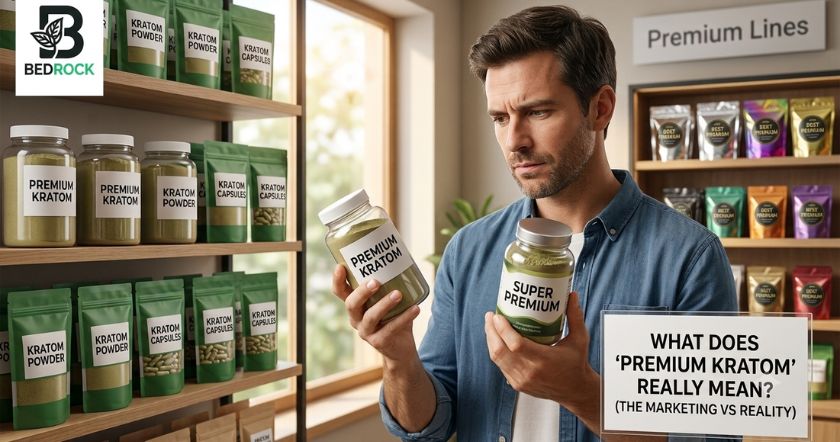
What Does Premium Kratom Really Mean?
The term “premium” can be seen used in Kratom today more than ever. Spend time in any online store, and you’ll encounter products touted as premier, super premium, high end, reserve or top-shelf. These names are confusing, and they give the impression of being the hottest thing, but honestly they are meaningless.
Premium is, of course, mainly a marketing phrase. In contrast to industries that have government-regulated grading systems, there is no national standard for what constitutes premium Kratom powder . In other words, two premium Kratom products with the same label could have drastic differences in sourcing, processing, freshness, testing and overall uniformity.
Knowledge of what actually drives product quality gives a consumer the tools to make smart purchases. Instead of focusing on flashy packaging or carefully chosen language, it is far better to look at measurable criteria like lab testing, transparency, origin and handling practices, and comp describing their overall reputation.
Try Premium Bedrock Botanicals Kratom Products
Why Use “Premium” So Consistently?
This gets attention because the term premium Kratom is viewed as being higher quality. It gives the impression that one product is better than another, despite limited evidence of this.
To date, no regulatory classification of Kratom (unlike food grades or pharmaceutical categories) has been uniformly accepted as a definition of premium Bedrock Kratom. In the case of branding, it is free game for companies to use that term.
And that does not mean with certainty a product sucks. That does mean, however, that consumers need to look further than the label.
Instead of just bringing up that a product is “premium,” trusted sellers explain why it deserves attention.
What Actually Defines High-Quality Kratom?
There are numerous measurable parameters of product excellence. Although none will guarantee greatness alone, a credible vendor will probably do quite a few of the following.
Responsible Sourcing
Quality begins at the source.
Trustworthy suppliers employ knowledgeable growers and harvesting partners who are familiar with all proper practices surrounding growing and harvesting. Over time, sourcing consistently tends to result in more dependable products.
Important premium Kratom sourcing considerations include:
- Established relationships with growers
- Careful harvesting practices
- Proper drying methods
- Clean handling throughout production
- Consistent supply chains
Expertise with transparent sourcing straight up builds confidence in product quality.
Independent Laboratory Testing
Perhaps the strongest indicator of premium Kratom quality is third-party laboratory testing.
Independent laboratories analyze products using standardized procedures that help verify important quality characteristics.
Laboratory testing commonly evaluates:
- Identity verification
- Purity
- Microbial screening
- Heavy metals
- Other potential contaminants
Companies that openly provide laboratory information demonstrate a stronger commitment to transparency than companies relying solely on marketing language.
Proper Manufacturing Standards
Even excellent raw material can lose quality through poor manufacturing.
Reliable vendors generally focus on:
- Clean processing environments
- Good manufacturing practices
- Proper equipment sanitation
- Controlled packaging procedures
- Batch consistency
Every production step influences the final product.
Important Interesting Topic For you!
Freshness Matters
Freshness often receives less attention than it deserves.
Proper storage helps maintain product quality during transportation and warehousing.
Quality-focused companies typically use packaging designed to reduce exposure to:
- Excess moisture
- Air
- Direct sunlight
- Heat
Fresh inventory rotation also contributes to overall consistency.
Clear Product Information
Transparency builds premium Kratom confidence.
Instead of making exaggerated promises, reputable companies provide straightforward information such as:
- Product name
- Batch identification
- Packaging details
- Laboratory availability
- Storage recommendations
The more information a company willingly shares, the easier it becomes for consumers to make informed decisions.
Marketing Claims vs Reality
Many phrases sound impressive but offer little useful information.
“Ultra Premium”
This phrase has no standardized definition.
One company’s ultra-premium product may be manufactured exactly the same way as another company’s regular product.
Without supporting evidence, the phrase remains a marketing language.
“Highest Quality Guaranteed“
Guarantees sound reassuring, but quality should also be supported by objective information.
Look for companies that explain their quality control process instead of relying only on broad statements.
“Best Kratom Available“
Quality is not measured by advertising slogans.
Consumers should focus on facts such as:
- Independent testing
- Transparent sourcing
- Manufacturing practices
- Customer education
- Consistent quality control
“Exclusive Formula”
Because Kratom is a natural botanical, this phrase may simply describe branding rather than a measurable difference.
Clear information is more valuable than vague promotional language.
Signs of a Trustworthy Vendor
Choosing a vendor often matters more than choosing products based solely on marketing labels.
Reliable companies typically demonstrate several qualities.
Transparency
They explain their sourcing, testing, and manufacturing processes.
Education
They publish informative content that helps consumers understand products rather than relying only on promotional messaging.
Consistency
They maintain quality standards across batches instead of frequently changing product descriptions.
Honest Marketing
Responsible businesses avoid unrealistic promises and focus on factual product information.
Accessible Customer Support
Good customer service helps answer questions about products, testing, shipping, and quality standards.
Questions to Ask Before Buying
Instead of asking whether a product is premium, consider asking:
- Is independent laboratory testing available?
- Does the company explain its quality standards?
- Is batch information provided?
- Does the business describe its sourcing practices?
- Does the website prioritize education over exaggerated marketing?
- Are product descriptions clear and transparent?
These questions provide much more useful information than marketing labels alone.
Why Transparency Is More Valuable Than Buzzwords
Marketing terms come and go, but transparency remains meaningful.
Companies willing to discuss their quality processes demonstrate accountability.
Consumers benefit when they can evaluate information instead of relying on assumptions created by attractive branding.
As more buyers become informed, transparency increasingly becomes one of the strongest indicators of a quality-focused company.
How Bedrock Botanicals Approaches Quality
At Bedrock Botanicals, the focus extends beyond marketing language. Rather than relying on labels alone, the company emphasizes transparency, responsible sourcing, and quality-focused practices that help customers make informed purchasing decisions.
Whether you’re exploring Kratom for the first time or you’re an experienced consumer, understanding the factors that influence product quality is far more valuable than choosing a product simply because it carries the word “premium.”
Taking the time to evaluate sourcing, testing, manufacturing practices, and company transparency can help you shop with greater confidence.
Final Thoughts
The phrase “premium Kratom” sounds appealing, but by itself it tells consumers very little.
True quality comes from measurable practices, not marketing slogans.
When comparing products, focus on evidence such as laboratory testing, transparent sourcing, careful manufacturing, proper packaging, and honest communication. These indicators provide a much clearer picture of product quality than promotional labels ever can.
An informed customer is always in a better position to evaluate products based on facts rather than advertising.
Frequently Asked Questions
Is A Higher Price Always A Sign Of Better Quality?
Not necessarily. Price alone does not indicate quality. It’s important to consider factors such as laboratory testing, sourcing, and transparency.
Why Is Third-Party Testing Important?
Independent laboratory testing helps verify product identity and screens for potential contaminants, supporting transparency and quality assurance.
How Can I Identify A Trustworthy Kratom Company?
Look for companies that provide clear product information, discuss their quality practices openly, offer laboratory testing, and avoid exaggerated marketing claims.
Should I Rely On Marketing Terms When Comparing Products?
Marketing terms can be useful for branding, but they should not replace objective information about sourcing, testing, manufacturing, and quality standards.
FDA Disclaimer
These statements have not been evaluated by the Food and Drug Administration (FDA). Kratom products are not intended to diagnose, treat, cure, or prevent any disease. This content is provided for educational and informational purposes only and should not be interpreted as medical advice.
How To Reset Your Kratom Tolerance Without Quitting
If you’ve been using Kratom for a while, you’ve probably noticed the same thing nearly every regular user eventually runs into: the dose that used to work just doesn’t hit the same way anymore. Maybe you started with two grams and felt great, and now you’re pushing six or seven just to get back to that baseline. That’s tolerance, and it’s one of the most common frustrations people run into with Kratom.
The good news is that you don’t have to quit cold turkey to fix it. A full Kratom tolerance reset is one option, sure, but plenty of people manage to walk their tolerance back down while still keeping Kratom in their routine. It takes a bit more discipline than just stopping altogether, but for a lot of users, it’s the more realistic path.
Third Eye: Gold Maeng Da – Bedrock Botanicals
Why Tolerance Builds In The First Place
Kratom’s active compounds, mainly mitragynine and 7-hydroxymitragynine, interact with certain receptors in the brain. With repeated use, your body adapts. Receptors become less sensitive, or your body starts processing the alkaloids more efficiently and clearing them faster. Either way, the result is the same: you need more to get the effect you used to get from less.
This isn’t unique to Kratom. It’s the same basic mechanism behind tolerance to caffeine, alcohol, or pharmaceutical opioids. The body is remarkably good at adjusting to whatever you throw at it consistently, which is great for survival but annoying when you’re trying to maintain a consistent experience with a plant you actually like using.
Why A Full Reset Isn’t Always Necessary
The internet is full of advice telling people to just stop for two to four weeks and start fresh. That works, no doubt about it. But it’s not realistic for everyone. Some people use Kratom for a personal wellness routine , energy, or mood support tied to their daily functioning, and a complete break isn’t practical or even desirable for them.
That’s where a tolerance “reset” without full cessation comes in. The idea is to scale things back enough that your receptors get a meaningful break, without removing Kratom from your life entirely.
Strategy 1: Lower The Dose Significantly
The simplest move is also the most effective one. If you’re used to taking 8 grams a day, drop down to 2 or 3 for a stretch of time, even if the effects feel underwhelming at first. Staying at a much lower Kratom dose for a week or two gives your receptors room to recover sensitivity without you having to go to zero.
This requires some patience. The first few days at a reduced dose can feel anticlimactic, especially if you’re used to a strong, reliable effect. Stick with it anyway. The point isn’t to feel amazing right now; it’s to let your system recalibrate so that smaller amounts start working better again.
Strategy 2: Space Out Your Doses
Frequency matters just as much as quantity. If you’re someone who doses three or four times a day, every single day, your receptors never really get a chance to reset between hits. Cutting back to once a day, or even every other day, can make a noticeable difference over a couple of weeks.
Some people find success with what’s sometimes called dose spacing: using Kratom only on certain days of the week rather than daily. For example, using it Monday, Wednesday, and Friday instead of every day gives your body 48 hours of recovery time between sessions, which is often enough to keep tolerance from creeping up the way it does with daily use.
Strategy 3: Rotate Strains
This one is debated, and the science behind it is more anecdotal than proven, but a lot of long-term users swear by Kratom strain rotation. The thinking is that different Kratom strains have slightly different alkaloid ratios, so switching between a few varieties (say, a red vein Kratom one week, a green or white the next) keeps your body from adapting to one specific alkaloid profile too completely.
Whether or not this is doing something biologically meaningful is hard to say definitively, but it doesn’t hurt to try, and many people report it helps stretch out the time before they need a true dose increase.
Strategy 4: Cut Out The In-Between Snacking
A lot of tolerance buildup isn’t from the planned, intentional doses; it’s from the small top-ups in between. Taking a little extra when you’re feeling tired in the afternoon, or a small dose just to “keep things going,” adds up fast and accelerates tolerance without you really noticing.
Being honest with yourself about how often you’re actually using Kratom, not just how often you planned to, is a big part of getting a handle on tolerance. Keeping a simple log for a week or two, even just jotting down the time and amount, can be eye-opening.
Strategy 5: Support Your Body’s Overall Wellness
Tolerance isn’t purely about the Kratom itself; it’s also about how well your body processes and clears it. Staying hydrated, eating regularly, and getting decent sleep all support the metabolic processes that help reset receptor sensitivity. None of this is a magic fix, but neglecting the basics while trying to manage Kratom tolerance tends to work against you.
Some people also pay attention to what else they’re consuming alongside Kratom. Heavy caffeine use, for instance, can sometimes mask how your tolerance is actually trending, making it harder to tell if your lower-dose strategy is working.
How To Maximize Your Kratom Experience: Potentiation Tips
How Long Does It Actually Take?
This varies a lot from person to person, depending on how long you’ve been using Kratom, how high your typical dose was, and how strictly you stick to a reduced routine. Some people notice a difference within a week of cutting back. Others need closer to three or four weeks of consistent lower dosing before they feel like their old baseline dose is working again.
The key is consistency over that period. Bouncing back and forth between a strict reduced schedule and old habits tends to slow the whole process down and can be more frustrating than just sticking with one approach.
Conclusion
It’s worth saying plainly: Kratom isn’t risk-free, and Kratom tolerance management strategies aren’t a substitute for paying attention to how it’s affecting your life. If you find yourself needing higher and higher doses just to feel normal, or if cutting back feels genuinely difficult rather than just inconvenient, that’s worth taking seriously rather than just treating as a dosing problem to optimize around. Talking to a doctor familiar with Kratom use, if you can find one, is a reasonable step if you’re noticing those patterns.
For most moderate, intentional users, though, the strategies above (lowering dose, spacing out use, Kratom rotating strains, cutting the in-between top-ups, and supporting your body’s basic needs) are usually enough to bring tolerance back down to a manageable level without having to give up Kratom altogether. It takes some patience and a bit of honesty about your actual habits, but it’s a realistic path that a lot of people have walked successfully.